

Decentralized exchanges (DEXs) let you swap tokens directly from your wallet using smart contracts—no centralized custody, no deposit/withdrawal flow, and often faster access to long-tail assets. But the mechanics are different from CEX order books: on most DEXs, pricing comes from liquidity pools and automated market makers (AMMs), and the risk profile is heavily shaped by volatility, liquidity depth, MEV, and impermanent loss.
This guide explains how DEX swaps work, how LP positions generate yield, what impermanent loss really means, and how to apply a practical risk framework (with a comparison table using LTV / threshold / bonus) to keep your DeFi activity disciplined.
What Is a DEX (Decentralized Exchange)?
A DEX is an exchange where trades execute via smart contracts. You keep control of your assets (non-custodial), and swaps occur on-chain, typically using AMMs rather than traditional order books.
Key Benefits of DEXs
- Non-custodial: funds stay in your wallet until you sign a transaction.
- Access to new/small-cap assets: pairs can exist without centralized listings.
- Composability: DEX liquidity integrates across DeFi (vaults, aggregators, lending, etc.).
- Transparency: liquidity, fees, and activity are visible on-chain.
Key Trade-Offs
- Smart-contract risk: bugs, exploits, upgrade risk.
- MEV & sandwich risk: adverse execution due to mempool dynamics.
- Liquidity risk: slippage can be large in shallow pools.
- Asset risk: fake tokens, transfer taxes, blacklists, honeypots.
How Swaps Work on DEXs: AMMs and Liquidity Pools
Most mainstream DEXs use an AMM (Automated Market Maker). Instead of matching buyers and sellers in an order book, an AMM prices swaps based on the pool’s token balances.
Liquidity Pool Basics (50/50 by Value)
A typical pool contains two assets (e.g., TOKEN/USDC). Liquidity providers deposit both assets, usually 50/50 by value at deposit time. When traders swap, they change the pool’s balance—and that changes the price.
Slippage: Why Trade Size Matters
Slippage is the difference between the expected price and the executed average price, caused by pool depth and trade size. Larger trades in smaller pools move the price more, creating worse execution.
- Low liquidity + large trade = higher slippage.
- High volatility periods can amplify slippage and MEV risk.
DEX Pricing and Arbitrage: Why Prices Converge Across Markets
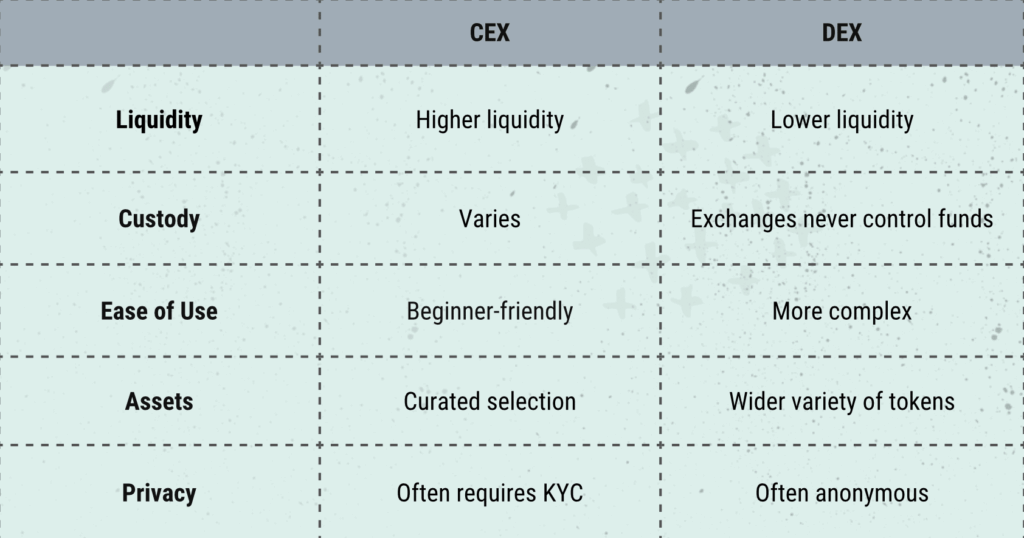
If a token becomes cheaper on a DEX than on a CEX, arbitrageurs buy on the DEX and sell on the CEX, pushing prices back toward alignment. In practice, arbitrage bots do most of this, constantly smoothing price differences—especially for liquid pairs.
What This Means for You
- DEX prices usually track broader market pricing, but can deviate during volatility or congestion.
- Thin pools can “misprice” temporarily, which impacts your swap execution and LP performance.
Liquidity Providing (LP): How LP Yield Is Actually Generated
As an LP, you deposit two assets into a pool and receive LP shares (LP tokens or an NFT position in concentrated-liquidity designs). Your income typically comes from:
- Swap fees: traders pay fees, which are distributed to LPs by pool share.
- Incentives (rewards): some protocols pay extra tokens to attract liquidity.
APY vs Compounded APY
- APY: annualized return estimate (methodology varies by protocol).
- Compounded APY: assumes frequent harvesting and reinvesting of rewards.
Important: high APY can be emissions-driven. If reward tokens decline or volume drops, realized returns can be far lower than displayed.
Impermanent Loss (IL): The Core LP Risk You Must Understand
Impermanent loss happens when your LP position ends up worth less than simply holding the two assets in your wallet, after their relative price changes. The AMM mechanism forces your position to rebalance as traders swap.
Intuition: “Selling the Winner, Buying the Loser”
- If TOKEN pumps, traders buy TOKEN out of the pool → you end up with less TOKEN and more of the paired asset.
- If TOKEN dumps, traders sell TOKEN into the pool → you end up with more TOKEN and less of the paired asset.
In directional markets, IL can dominate fee income—especially when volatility is high and volume doesn’t compensate.
When Providing Liquidity Makes Sense (and When It Doesn’t)
Often Better: Range-Bound / Sideways Markets
- Price oscillates inside a band → frequent swaps → steady fees.
- Relative price doesn’t trend hard → IL pressure is typically lower.
Often Worse: Strong Uptrends or Downtrends
- Directional moves amplify IL.
- Fees may not offset the rebalancing effect.
High-Risk Zone: Small-Cap + High Volatility
- Low liquidity → high slippage and worse execution.
- Pump/dump dynamics → aggressive IL and drawdowns.
- Higher scam surface area (blacklists, taxes, honeypots).
Risk Framework Table: LTV / Threshold / Bonus (How to Compare Strategies)
Below is a practical comparison table you can use to evaluate DeFi strategies. While LTV and liquidation threshold are native to lending, they’re still useful as a universal risk language when you combine LP + lending (common in “leveraged LP” or “looping” setups). Use this table as a simplified framework for selecting strategy types and setting strict limits.
| Strategy Type | LTV (Typical Range) | Liquidation Threshold (Typical) | Bonus / Penalty (Typical) | Main Risk Driver | Best Market Regime |
|---|---|---|---|---|---|
| Spot Swap (no leverage) | N/A | N/A | Slippage / MEV impact | Execution quality + token risk | Any, but avoid thin pools |
| LP: Stable/Stable | 0–30% (if used as collateral) | 70–90% (if lent against) | Liquidation bonus ~5–10% (if borrowed) | Depeg risk + smart-contract risk | Sideways; stable conditions |
| LP: Major/Stable (e.g., ETH/USDC) | 0–50% (if used as collateral) | 75–85% (if borrowed) | Liquidation bonus ~5–12% (if borrowed) | Directional volatility + IL | Range-bound / mild trend |
| LP: Volatile/Volatile | 0–40% (if used as collateral) | 65–80% (if borrowed) | Liquidation bonus ~8–15% (if borrowed) | High IL + price correlation breaks | Only if you accept volatility |
| Leveraged LP (LP + borrowing) | 50–85%+ | 70–85% (asset-dependent) | Liquidation bonus ~5–15% | Liquidation risk + IL compounding | Strictly controlled ranges |
How to use this table: treat higher LTV as higher fragility. If you don’t fully understand liquidation mechanics, avoid leveraged LP. For pure LP without borrowing, ignore LTV/threshold and focus on volatility, fee APR, and IL exposure.
DEX Safety Checklist (Before You Swap)
- ☑️ Verify the token contract: confirm the exact address from a trusted source.
- ☑️ Check liquidity depth: avoid pools with shallow liquidity vs your trade size.
- ☑️ Set slippage intentionally: too low may fail; too high increases MEV exposure.
- ☑️ Use a DEX aggregator when appropriate: better routing can reduce slippage.
- ☑️ Watch for transfer taxes / honeypots: unexpected fees or blocked sells are critical red flags.
LP Due Diligence Checklist (Before You Provide Liquidity)
- 🔘 Protocol audits: who audited, what scope, how recent, and any unresolved issues.
- 🔘 TVL and liquidity trend: sudden spikes/drops can signal mercenary liquidity.
- 🔘 Reward sustainability: is APY mostly fees, or mostly emissions?
- 🔘 Token risk assessment: admin keys, upgradeability, blacklist features, pausable transfers.
- 🔘 Market regime fit: avoid LP during strong directional moves unless you intentionally want that exposure.
Portfolio Rules: Simple Risk Management That Actually Works
1) Cap Allocation Per Protocol
A practical rule: do not allocate more than 5% of your total portfolio to a single protocol. This protects you from protocol-specific failure modes (exploits, bugs, governance attacks).
2) Diversify by Risk Type
- Split between stable strategies and volatile strategies.
- Split across chains/ecosystems if you’re active in multiple networks.
- Keep a reserve outside DeFi to avoid forced exits during drawdowns.
3) Avoid Leverage Until You Can Model Liquidation
If you can’t explain your liquidation threshold, liquidation bonus, and expected drawdown under stress, you’re not ready for leveraged LP.
FAQ
1. What’s the difference between a DEX and a CEX?
A CEX uses custody and an order book, and you trade using an exchange account. A DEX executes swaps via smart contracts, typically from your wallet, using AMM pools for pricing.
2. Why do I get worse prices than I expected on a DEX?
Usually because of slippage (pool depth vs trade size), volatility, or MEV/sandwich effects. Deeper liquidity and better routing generally improves execution.
3. Is providing liquidity always profitable?
No. LP returns depend on fee volume, volatility, and impermanent loss. In strong trends, IL can exceed fees—especially in volatile pairs.
4. What is impermanent loss in one sentence?
It’s the performance gap between holding assets in a pool versus holding them in your wallet after their relative price changes.
5. Why do protocols show very high APY?
Often because incentives include emissions of the protocol token. If that token declines, the displayed APY can diverge sharply from realized returns.
6. Should beginners start with stable pools?
Stable/stable pools reduce directional volatility, but they introduce depeg risk. They can be a simpler starting point than volatile/volatile LP, provided you understand the stability assumptions.