

Staking and delegation are core mechanics in Proof of Stake (PoS) blockchains, where network security is driven by economic collateral rather than raw compute. For investors, staking is often framed as “protocol-native yield”: you lock (or commit) an asset to help secure consensus and receive rewards in return.
In practice, staking is not a risk-free deposit. The market has repeatedly shown that losses can come from multiple layers: the base network and token economics, validator operations, smart contract/protocol design, and liquidity/peg dynamics—especially when you move from classic delegation to liquid staking derivatives (LSTs).
This guide covers:
- How PoS works (roles, incentives, rewards)
- How delegation works for non-validators
- How to evaluate validators as infrastructure operators
- How liquid staking works and what it changes for capital efficiency
- Where investors historically lost money (real-world case studies embedded where relevant)
Educational content only. Not financial advice.
How Proof of Stake (PoS) Works: Validators, Stake, and Incentives
Validators: What They Do and Why They Matter
Validators are network participants responsible for:
- Validating transactions
- Proposing/attesting to blocks
- Maintaining liveness and (where applicable) finality
- Enforcing consensus rules as part of the protocol
From an investor’s perspective, a validator is an infrastructure operator with operational risk: uptime, client software, upgrades, and incident response all influence realized yield.
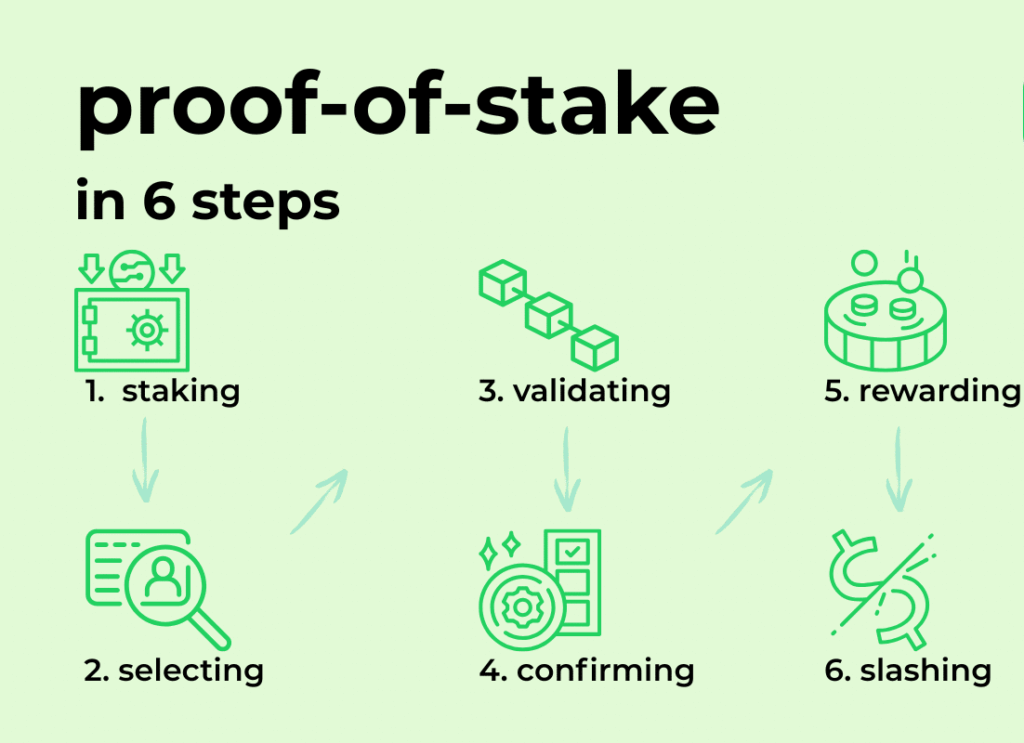
What “Stake” Means in PoS
To participate in PoS consensus, validators post stake—a bond denominated in the network’s native asset. The economics are simple:
- Operate correctly → earn rewards
- Break rules or fail critically → face penalties
That bond is what makes attacks expensive: violating consensus rules puts capital at risk.
Where Rewards Come From: Fees and Protocol Issuance
Validator rewards typically come from:
- Transaction fees paid by users
- Protocol rewards/issuance (if the network subsidizes security with inflationary emissions)
Delegators receive rewards proportional to their share of stake, minus the validator’s commission.
Slashing: Penalties for Rule Violations (and Operational Failures)
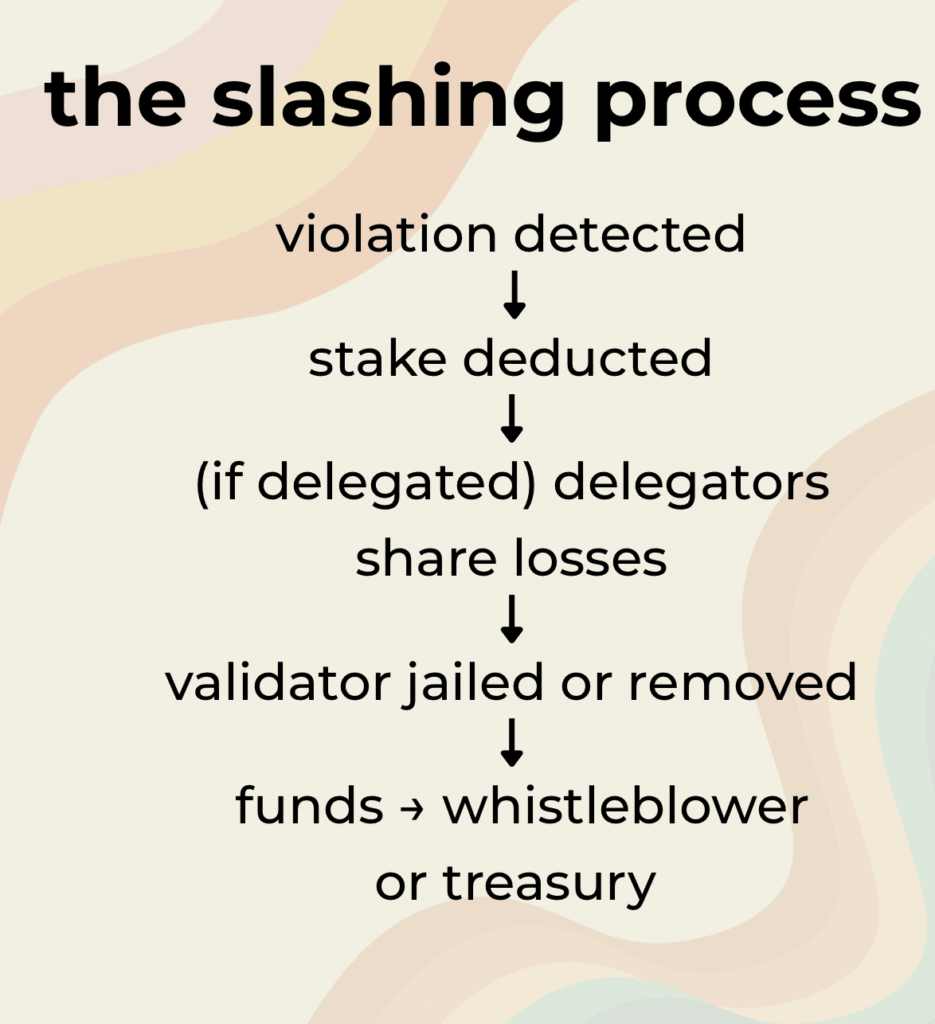
Slashing is the protocol’s enforcement mechanism: if a validator violates network rules (or in some systems repeatedly fails duties), the validator’s stake can be penalized. For investors, the key point is that “penalties” are not only about malicious behavior—they can also be a function of software bugs, misconfiguration, or poor operational practices.
Real-world example (operational risk, not fraud): On Ethereum, validator participation and reward outcomes have been negatively impacted in incidents involving client performance and upgrade-related issues. While this doesn’t always mean catastrophic loss of principal, it can materially reduce realized yield—especially at institutional scale.
Delegation: How Non-Validators Earn Staking Yield
What Delegation Is (Conceptually)
Delegation lets users participate in staking without running validator infrastructure. You assign your stake to a validator, increasing that validator’s weight in consensus and earning a share of the validator’s rewards.
In many PoS networks, delegation is a protocol-native action rather than “handing coins to a person.” The exact custody model varies by chain and method (native staking vs. third-party service), which is important for risk assessment.
Why Staking Is Often Considered “Lower Risk” (Relative to Trading)
Compared to active trading or high-leverage DeFi loops, staking is often treated as a “base yield” strategy because:
- Rewards are protocol-driven rather than timing-driven
- The operational workflow is straightforward
- Risk can be structured into layers (network/validator/protocol/liquidity)
But staking yield in percentage terms does not protect you from a large drawdown in the underlying asset.
Classic Staking Risks: Where Investors Actually Lost Money
Risk #1: Network/Token Economics Break (Asset Goes Near-Zero)
This is the dominant risk layer. If the base asset collapses, staking rewards become irrelevant.
Case study: Terra (UST/LUNA), May 2022. UST lost its dollar peg and LUNA collapsed toward zero in a rapid unwind, wiping out tens of billions in market value. Network operations were impacted during the crisis period.
Investor takeaway: Network-level economic failure overrides validator excellence. If token design breaks, “yield” becomes yield on a failing asset.

Risk #2: Network Degradation (Outages, Liveness Issues, Finality Interruptions)
Even major networks can suffer outages or liveness issues. For staking, that can mean missed rewards; for DeFi, it can mean delayed transactions, impaired liquidations, and wider market dislocations.
Case study: Solana outage, February 6, 2024. Block finalization halted for hours due to a bug, requiring coordination and a restart/patch process.
Investor takeaway: “Technical” incidents can translate into market risk: liquidity stress, temporary spreads, and LST discounts can widen when users rush for exits.
Risk #3: Validator Operations (Uptime, Client Issues, Penalties)
Validators are operational systems. Your realized yield is sensitive to uptime, client performance, upgrade execution, and incident response.
Real-world pattern: Client performance issues and upgrade-related edge cases have, at times, reduced validator participation and rewards. These are not necessarily “scams”—they are operational failures that impact return.
Investor takeaway: Treat validator selection like selecting a production infrastructure provider.
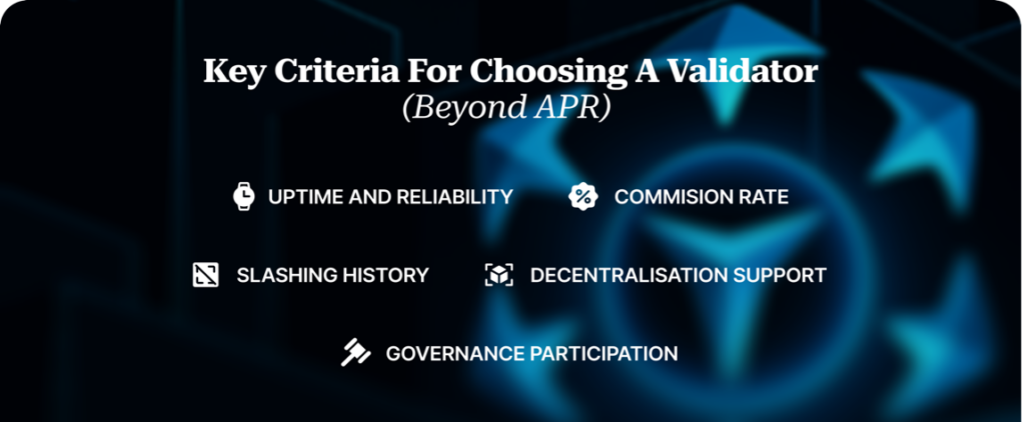
How to Choose a Validator: A Technical Checklist
1) Uptime and Participation
- Consistent uptime and stable participation
- Minimal missed duties/slots/attestations (chain-dependent)
- Fast, competent handling of network upgrades
2) Commission (Fee)
Validator commission reduces your net yield. However:
- Excessive fees cut returns
- Near-zero fees can be marketing-driven and may correlate with weaker ops
3) Self-Bond / Skin in the Game
A higher self-bond indicates stronger alignment: the operator has meaningful capital at risk alongside delegators.
4) Reputation and Concentration Trade-Off
Top validators often have robust infra, but overly concentrated stake can introduce governance and systemic risks. A common “institutional” posture is: reliable, but not overly dominant.
Liquid Staking (LST): What It Is and Why It Exists
Why Liquid Staking Was Invented
Classic staking can reduce capital flexibility: funds may be locked, and unstaking can take time. Liquid staking addresses this by issuing a liquid derivative token (an LST) representing your staked position.
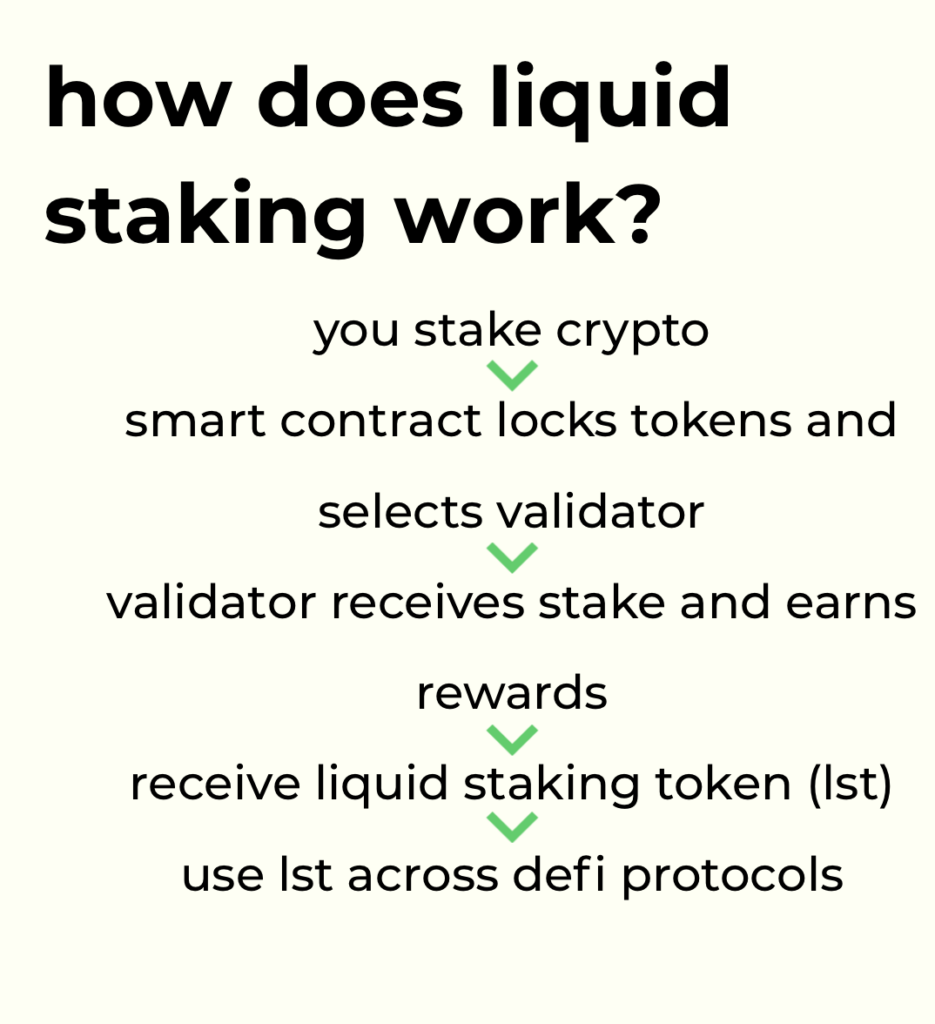
How Liquid Staking Typically Works
- You deposit the base asset into a liquid staking protocol
- The protocol delegates across validators
- You receive an LST (liquid receipt token)
- You can hold, trade, or use the LST in DeFi
How LST Yield Accrues: Rebasing vs. Price Accrual
Depending on protocol design, yield can appear as:
- Rebasing (token balance increases over time), or
- Price accretion (the LST’s exchange rate/value vs. base asset rises)
For investors, the practical takeaway is the same: yield accrues inside the LST while you hold it.
Benefits of Liquid Staking for DeFi Investors
1) Capital Efficiency: Use LSTs in Lending, DEX LP, and Structured Strategies
LSTs can often be used as:
- Collateral in lending protocols
- Liquidity in DEX pools (LP fees + incentives, where applicable)
- Inputs to structured products (vaults, delta-neutral, etc.)
Investor logic: combine protocol staking yield with DeFi utilization—but only after pricing in added risk layers.
2) Faster Exit (Relative to Unstaking)
Instead of waiting for an unstaking/unbonding period, investors can often sell or swap the LST, improving tactical flexibility—especially during volatility spikes.
Liquid Staking Risks: Real-World Failures and Practical Mitigations
Risk #1: Validator Risk Still Exists (Including Slashing/Penalties)
Even with LSTs, the underlying stake is delegated to validators. Operational failures can still reduce yield and introduce penalty risk.
Risk #2: Protocol Risk (Smart Contract Bugs, Admin Keys, Integration Surfaces)
LSTs introduce a new risk layer: smart contracts and governance/admin mechanisms.
Case study: Ankr (aBNBc), December 2022. A compromise of privileged access led to abnormal minting of the liquid staking token and rapid market impact via swaps. The base chain continued functioning, but the “wrapper” was the failure point.
Investor takeaway: LST “protocol risk” is distinct from base-chain risk. Audit quality, upgrade controls, and key management are first-class due diligence items.

Risk #3: Depeg / Discount Risk (LST Trades Below Its Implied Value)
LSTs can trade at a discount to the underlying asset due to liquidity imbalance, panic selling, or leverage unwind cycles (especially when LSTs are heavily used as lending collateral).
Case study: stETH discount vs. ETH, June 2022. stETH traded materially below ETH during stress, reflecting liquidity and deleveraging pressures.
Investor takeaway: Arbitrage may restore parity over time, but if you need to exit during stress, you may realize the discount immediately.
Risk #4: Custodial/Operational Risk (If Using a Third-Party Service)
If you stake through a custodial provider rather than native delegation, you introduce key management and operational process risks.
Case study pattern: The industry has seen incidents where key management failures impaired access or withdrawal capabilities. This is not a “blockchain failure,” but a custody/operator failure.
Investor takeaway: If custody is involved, evaluate provider controls as seriously as protocol code.
Risk #5: Exchange-Rate Mechanics Risk (Non-Hack, Design/Edge Cases)
Some LST designs can produce unexpected exchange-rate behavior under edge conditions (e.g., reward accounting, rate calculation, external transfers interacting with protocol mechanics).
Case study pattern: The market has observed episodes where exchange-rate calculations were skewed due to protocol mechanics rather than direct exploits.
Investor takeaway: Treat exchange-rate logic as a core risk vector. Read docs, monitor incident history, and favor protocols with mature controls.
Classic Staking vs. Liquid Staking (LST): Side-by-Side Comparison
| Dimension | Classic Staking (Delegation) | Liquid Staking (LST) |
|---|---|---|
| Liquidity | Often constrained (unbonding/unstaking delay) | Typically higher (LST can be traded/used) |
| Risk Layers | Network + Validator | Network + Validator + Protocol + Liquidity |
| Return Profile | Protocol-native staking yield | Staking yield + DeFi utilization potential (higher complexity) |
| Complexity | Lower | Medium to high |
| Best Fit | Baseline/long-term holders | Active DeFi investors optimizing capital efficiency |
Investor Framework for DeFi Catalogs: Risk Layers You Should Display
If you run a DeFi tools directory, the most useful way to standardize staking/LST listings is to score risk by layer:
- Network Risk: chain stability + token economics + systemic dependency
- Validator Risk: operator uptime, client quality, penalty history, decentralization
- Protocol Risk: smart contracts, governance/admin keys, audits, dependency map
- Liquidity Risk: depth, depeg history, leverage loops, exit pathways
For each listing, consider showing:
- LST type: rebasing vs price-accrual
- Depeg history and market conditions when it occurred
- Main liquidity venues (DEX/CEX) and depth
- Validator diversification and stake concentration
- Audit status, bug bounty, and past incidents (with dates)
A Practical Action Plan (Classic First, LST Second)
If you want to approach staking systematically:
- Start with classic staking on a mature network where you understand the token’s fundamentals.
- Select validators using the checklist: uptime/participation, commission, self-bond, operational track record.
- Assess network risk: incident history, tokenomics, liquidity structure, systemic dependencies.
- Only then consider liquid staking and DeFi utilization.
- For any LST, explicitly evaluate: liquidity depth, depeg history, protocol security posture, and your exit plan.