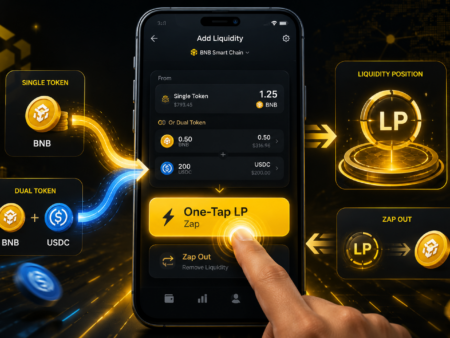

RHEA Finance is expanding into the TRON ecosystem, opening a new route for TRON users to access cross-chain decentralized finance from a single interface. The integration is designed to make trading, lending, and borrowing across multiple blockchains feel less fragmented for users who already rely on TRON for stablecoin activity and large-volume transfers.
That matters because TRON rarely gets the same DeFi spotlight as Ethereum, Solana, or Base, even though its on-chain stablecoin footprint remains one of the largest in crypto. TRON has become a major network for moving digital dollars, settling payments, and parking liquidity. What it has not been known for, at least to the same extent, is being a leading destination for DeFi experimentation. RHEA Finance is effectively betting that this gap creates an opportunity.
TRON’s Stablecoin Strength Makes It a Logical Target
TRON’s position in crypto has long been tied to scale and efficiency in stablecoin transfers. The network has built a strong identity around high-volume movement of dollar-based assets, especially USDT. This has made it useful for payments, settlements, and treasury movement, but less associated with the kind of complex DeFi activity that tends to dominate headlines elsewhere.
That is precisely why the RHEA integration stands out. It enters an ecosystem where users and liquidity already exist at scale, but where multichain DeFi access can still feel too cumbersome for average participants. In practice, many users who want to reach DeFi across several networks are still forced to work through bridges, extra wallets, route selection, manual chain switching, unfamiliar contract addresses, and constant asset verification. Experienced users may tolerate those steps, but many retail users stop before completing the process.
TRON offers a real-world environment to test whether that friction can be meaningfully reduced. Its user base is large, its transfer activity is heavy, and its liquidity base is already well established. The missing piece has been a simpler way to connect that liquidity to broader DeFi functionality.
What RHEA Finance Actually Adds
RHEA Finance is built from the merger of Ref Finance and Burrow Finance, two established DeFi products from the NEAR ecosystem. Its model centers on simplifying multichain execution through NEAR’s intents-based infrastructure. Instead of making users manage each operational step themselves, the platform lets them define the outcome they want while the backend handles execution logic.
Under this structure, a solver network and NEAR-based signing system manage routing and transaction execution behind the scenes. Chain Signatures are also used so that NEAR accounts and smart contracts can sign and execute actions across multiple blockchain environments. In practical terms, this means users do not have to manually piece together bridges, swaps, and transfers just to complete one DeFi action.
For TRON users, the pitch is straightforward: open one interface, choose the intended result, sign, and let the system handle the route. That does not eliminate all complexity under the hood, but it does reduce how much of that complexity is exposed to the end user.
Why Simpler Multichain Access Matters
Cross-chain DeFi has often promised convenience, but for many users it has delivered a process that still feels overly technical. The ability to access liquidity across networks is valuable only if ordinary users can do so without feeling like they are assembling a transaction stack from scratch every time.
That is where RHEA’s TRON integration becomes more important than a routine chain-expansion headline. It is not just another protocol adding another network logo to its homepage. It is a direct attempt to connect one of crypto’s busiest stablecoin ecosystems to a more abstracted, easier-to-use DeFi experience.
If the model works, TRON users could gain exposure to broader DeFi markets without having to leave the environment they already understand. For a network with a strong payments-first identity, that could become a major step toward activating more of its on-chain capital in productive financial use cases.
The Limits of the “One-Click” Narrative
At the same time, the smoother user experience does not remove every caveat. RHEA’s own documentation on PassKey accounts makes that clear. A passkey functions as an identity and signing mechanism, but it is not the same thing as a traditional on-chain wallet. That distinction matters for security, control, and account recovery.
The platform notes that passkey-only accounts can become unrecoverable if users do not add a backup control method. It also recommends binding an external wallet soon after account creation. In some cases, including certain borrowing functions with outbound transfers, linking an external wallet is strongly recommended before proceeding.
This does not undermine the product’s value, but it does bring realism to the conversation. The front end may feel easier, yet user safety still depends on account setup, wallet binding, and recovery planning. In other words, abstraction improves usability, but it does not completely erase responsibility.
What TRON Stands to Gain
TRON has long had far more visibility as a stablecoin rail than as a DeFi powerhouse. That imbalance helps explain why a cross-chain trading and lending platform would find the network attractive. There is already a large amount of dollar liquidity on TRON, but not all of it is deeply engaged in broader DeFi activity.
RHEA’s integration gives that liquidity a possible path into more active use. Instead of requiring users to abandon familiar rails, it offers a way to extend what they can do from a more unified entry point. For TRON itself, that could support a deeper DeFi identity over time without changing the network’s core role as a major stablecoin settlement layer.
It also suggests where chain abstraction may prove its value first. The strongest opportunity may not be on networks already saturated with advanced DeFi users, but on chains where people already move capital efficiently and only need a simpler way to access more sophisticated financial tools.
A More Meaningful Chain Integration Story
Most integration announcements in crypto are easy to ignore. A protocol adds support for another network, posts a launch thread, and the story ends there. This one carries more substance because it connects several broader themes shaping DeFi in 2026.
- TRON’s role as one of the most important homes for USDT liquidity
- NEAR’s continued development of intents and cross-chain signing infrastructure
- The push to make multichain DeFi usable for ordinary users rather than only advanced traders
These threads make the RHEA-TRON connection more than a technical expansion. It becomes a test of whether chain abstraction can move from theory into everyday utility in one of crypto’s most active value-transfer environments.
Final Thoughts
The main story is simple: a DeFi product built to hide cross-chain complexity has chosen one of the busiest stablecoin ecosystems in crypto as a proving ground. That makes this integration relevant not only for TRON users, but for the broader direction of decentralized finance.
If RHEA can deliver a genuinely smoother experience while keeping security and recovery practical, it may offer a preview of where DeFi products are heading next. In that sense, this integration may end up saying more about the future of user-friendly multichain finance than many louder launches across the market.