
Chainlink has introduced a major upgrade to its Data Streams infrastructure, enabling near real-time pricing for U.S. stocks and ETFs across decentralized finance (DeFi) platforms. The new system delivers continuous 24/5 data coverage, marking a significant step toward bridging traditional financial markets and blockchain-based applications.
This development reshapes the Chainlink price narrative, as the protocol now provides DeFi builders with access to equity data representing an estimated $80 trillion in global market value. By bringing institutional-grade financial data on-chain, Chainlink is positioning itself at the center of the rapidly expanding tokenized real-world asset (RWA) ecosystem.
Chainlink Eliminates Data Gaps in On-Chain Equity Markets
Historically, most blockchain-based data feeds for equities have been limited to a single daily price update during standard U.S. trading hours (9:30 AM to 4:00 PM ET). This limitation created inefficiencies, preventing DeFi protocols from accurately reflecting market conditions outside those hours.
With the launch of 24/5 data streams, Chainlink closes that gap. DeFi applications can now access continuous pricing updates, allowing for:
- More accurate synthetic asset pricing
- Improved automated trading strategies
- Reliable collateral valuation in lending protocols
- Enhanced risk management across DeFi markets
This upgrade enables on-chain financial products to behave more like their traditional counterparts, significantly improving usability and trust.
Institutional Integration Strengthens Chainlink’s Position
Chainlink’s infrastructure is already integrated with major global financial institutions, including Swift, Euroclear, JPMorgan, Mastercard, UBS, and Fidelity International. These partnerships demonstrate that the protocol is not limited to crypto-native use cases but is increasingly embedded in traditional finance workflows.
As institutional players continue exploring blockchain-based settlement and tokenization, Chainlink’s oracle network becomes a critical layer connecting off-chain data with on-chain execution.
How Equity Data Streams Impact the $LINK Token
The long-term value of the $LINK token is closely tied to demand for Chainlink’s oracle services. Each DeFi protocol that integrates live equity data streams contributes to ongoing fee generation, typically paid in $LINK.
With support already spanning more than 40 blockchain networks, the potential demand base is broad and diversified. Unlike many DeFi tokens driven primarily by retail speculation, Chainlink benefits from institutional adoption, which may provide more stable and sustained growth.
As more platforms adopt tokenized equities and integrate real-time data feeds, the utility of $LINK is expected to increase alongside network usage.
RWA Market Growth Accelerates Chainlink Adoption
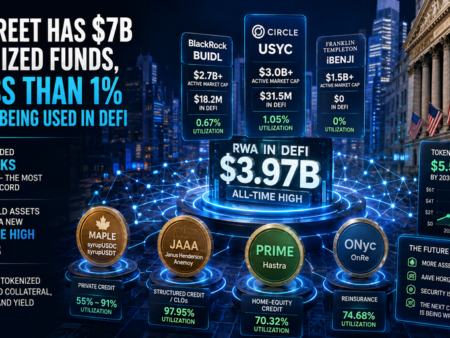
The tokenized real-world asset sector has grown to approximately $27 billion, reflecting increasing demand for blockchain-based exposure to traditional financial instruments such as stocks, bonds, and funds.
Reliable pricing data is essential for these assets to function correctly. Chainlink has established itself as a leading oracle provider, and the expansion into live equity data strengthens its role in this ecosystem.
If tokenized equities continue to scale toward institutional forecasts, Chainlink’s infrastructure could become a foundational component of the global financial system, making it increasingly difficult for competitors to replicate its network effects.
$LINK Price Outlook: Key Levels to Watch
Despite the bullish fundamental developments, $LINK remains in a broader downtrend. Technical indicators show that the 200-day simple moving average (SMA) continues to act as resistance, while the 50-day SMA remains below it—typically a bearish signal.
At the time of writing, $LINK is trading in the range of $9.14 to $9.25, still down approximately 34% over the past year.
Traders are closely watching the $9.50 resistance level. A sustained breakout above this zone could signal renewed bullish momentum, particularly if supported by increased institutional adoption following the Data Streams upgrade.
Macro Outlook: Can Infrastructure Tokens Rebound in 2026?
The broader outlook for infrastructure tokens like Chainlink depends on macroeconomic conditions and overall market sentiment. Risk appetite in both traditional and crypto markets will play a key role in determining whether capital flows back into DeFi.
If global uncertainties ease and institutional participation in blockchain ecosystems continues to grow, Chainlink could benefit from its unique position at the intersection of traditional finance and decentralized infrastructure.
Conclusion
Chainlink’s launch of 24/5 live equity data streams represents a critical milestone for DeFi. By delivering real-time stock market data on-chain, the protocol is enabling a new generation of financial applications that closely mirror traditional markets.
As tokenized assets gain traction and institutional adoption accelerates, Chainlink’s role as a data infrastructure provider may become even more central—potentially driving long-term value for both the network and the $LINK token.