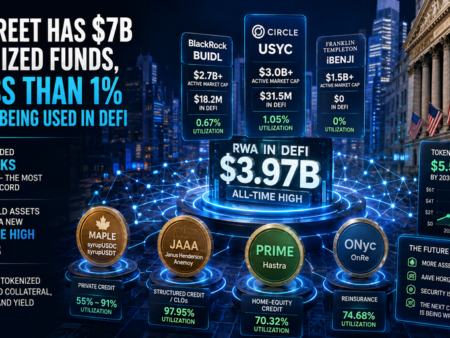

The race to bring traditional finance onto blockchain rails is accelerating, and decentralized finance (DeFi) is entering a defining moment. As major institutions roll out tokenized assets and regulated on-chain infrastructure, DeFi is being forced to confront a critical question: can it win the trust of institutional capital?
With more than $330 billion in on-chain capital already in circulation, the competition is no longer theoretical. It is a direct battle over who will control the future flow of digital finance.

Wall Street’s Rapid Move Into Tokenized Finance
Throughout early 2026, traditional financial institutions made a series of decisive moves that significantly reshaped the DeFi landscape. Major players introduced tokenized securities, 24/7 trading systems, and instant settlement mechanisms—all within regulated frameworks.
These developments include:
- Tokenized securities platforms with round-the-clock trading
- Stablecoin-based settlement infrastructure
- Regulatory approval for tokenized asset trading
- Institutional-grade custody and clearing solutions
Crucially, regulators have signaled a technology-neutral stance, allowing tokenized assets to receive the same treatment as traditional securities. This removes a major barrier for institutional adoption.
The $330 Billion Opportunity at Stake
The total pool of on-chain capital is already massive and continues to grow:
| Asset Category | Estimated Value |
|---|---|
| Stablecoins | $317 Billion |
| Tokenized U.S. Treasuries | $13 Billion |
| Tokenized Stocks | $1 Billion |
This capital will inevitably expand as tokenization accelerates. The real question is where it will flow: into open DeFi protocols or regulated financial systems.
DeFi’s Core Advantage: Composability
DeFi’s biggest strength remains composability—the ability for protocols to seamlessly connect and build on each other without permission. This enables advanced financial products, automated strategies, and rapid innovation.
However, this same feature introduces systemic risks when control mechanisms fail.
The Trust Problem: Security and Governance Risks
Recent incidents have exposed a growing weakness in DeFi: the control layer. Instead of smart contract bugs, many major exploits now originate from compromised admin keys, governance flaws, or access control vulnerabilities.
A recent high-profile exploit demonstrated how quickly risk can spread across interconnected protocols. When one system fails, the effects can cascade through vaults, collateral systems, and yield strategies.
Industry data highlights the scale of the issue:
- Private key compromises accounted for nearly 44% of stolen crypto in 2024
- Over $2.8 billion was lost in hacks during 2025
- The majority of attacks targeted infrastructure, not smart contracts
This trend is reshaping how institutions evaluate risk in DeFi.
Why Institutions Are Choosing Regulated Alternatives
Traditional financial platforms are now offering many of DeFi’s benefits—such as instant settlement and 24/7 trading—without exposing users to governance risks or permissionless vulnerabilities.
These systems operate within:
- Regulated exchanges
- Broker-dealer frameworks
- Centralized clearinghouses
- Strict compliance environments
For institutional investors, this combination of innovation and oversight is increasingly attractive.
What DeFi Must Do to Compete
To remain competitive, DeFi must significantly upgrade its operational standards. Key improvements include:
- Stronger multi-signature security practices
- Timelocks for critical administrative actions
- Segmentation of permissions to limit attack impact
- Transparent dependency mapping across protocols
- Faster incident disclosure and response times
These changes may not be flashy, but they are essential for building institutional confidence.
Two Possible Futures for DeFi
Bull Case: DeFi Earns Institutional Trust
If DeFi successfully improves governance and security:
- Institutions begin using DeFi for structured financial strategies
- Composability becomes a premium feature layered on top of traditional rails
- DeFi captures 5%–10% of on-chain capital ($16B–$33B)
Bear Case: Institutions Stay Away
If control-layer risks persist:
- Capital remains within regulated platforms
- Tokenization grows without DeFi involvement
- DeFi captures less than 1% of the market (under $3B)
The Bottom Line
Blockchain adoption by Wall Street is no longer a future scenario—it is happening now. Traditional finance has proven it can deliver on-chain efficiency within regulated systems.
For DeFi, the challenge is no longer about innovation. It is about trust.
To compete for the next wave of institutional capital, DeFi must demonstrate that its open, composable infrastructure can operate with the same level of reliability, transparency, and risk control as traditional financial systems—without sacrificing its core advantages.
The next phase of DeFi will not be defined by technology alone, but by whether it can meet the standards of the institutions it seeks to attract.