
The convergence of artificial intelligence and decentralized finance continues to accelerate as PancakeSwap has officially joined the BitAgent ERC-8183 Agent Marketplace Skill Ecosystem. The integration introduces AI-powered functionality that allows developers to connect PancakeSwap capabilities directly into autonomous agents capable of executing complex on-chain DeFi actions.
The move marks another step toward a broader vision often referred to as the “Open Agent Internet,” where AI agents can interact with decentralized applications as independently operating entities rather than relying on constant human input.
PancakeSwap Opens Its DeFi Infrastructure to AI Agents
As one of the largest decentralized exchanges operating within the BNB Chain ecosystem, PancakeSwap already powers a substantial portion of on-chain trading activity. The protocol enables users to swap digital assets, contribute liquidity, and participate in various yield-generating opportunities across multiple blockchain networks.
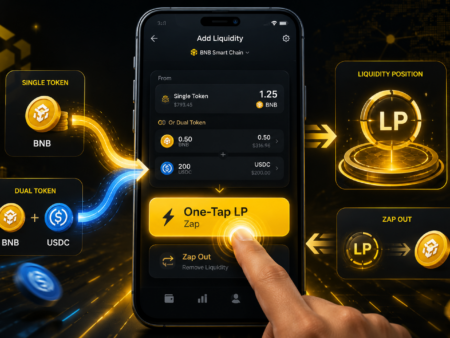
Through the BitAgent ERC-8183 Marketplace integration, these capabilities become available as reusable AI skills. Instead of manually navigating interfaces, connecting wallets, and approving transactions, developers can allow intelligent agents to perform these tasks programmatically.
AI agents integrated with PancakeSwap can now execute a range of DeFi operations, including:
- Autonomous token swaps
- Liquidity pool management
- Yield farming strategy execution
- Portfolio optimization workflows
- Multi-step DeFi automation processes
- On-chain transaction coordination
This removes much of the friction traditionally associated with decentralized finance operations and creates opportunities for advanced automation.
Understanding the Role of ERC-8183
The technical foundation behind this integration comes from the ERC-8183 framework, a standard designed specifically for AI agent ecosystems. It establishes a structure through which agent skills can be represented, discovered, and combined across decentralized environments.
Rather than building every feature from the ground up, developers gain access to modular functionality within the marketplace and can combine multiple services into larger automated systems.
For example, an AI agent could simultaneously:
- Monitor market conditions
- Execute a PancakeSwap trade
- Adjust liquidity allocations
- Track performance metrics
- Rebalance positions automatically
The composable nature of the marketplace significantly reduces development complexity while accelerating deployment.
PancakeSwap Skills Become Part of an Emerging AI Economy
The BitAgent Marketplace introduces more than just interoperability. It also creates an economic model around AI capabilities.
Skill creators can monetize the tools they contribute, while developers only pay for the specific functionality they consume. This creates a service-based ecosystem where agent capabilities become digital products with measurable value.
Instead of treating AI integrations as isolated utilities, the marketplace establishes an environment where autonomous functions can evolve into a scalable economic layer for Web3 applications.
Unibase AIP 2.0 Adds Persistent AI Memory
Powering the infrastructure beneath the marketplace is Unibase AIP 2.0, which delivers a decentralized memory layer for AI agents.
Persistent memory addresses one of the largest limitations facing autonomous systems. Without it, every interaction effectively begins from scratch, reducing an agent’s ability to improve and adapt over time.
With persistent context enabled, AI agents can retain information such as:
- Past user interactions
- Transaction patterns
- Portfolio preferences
- Historical strategy performance
- Active workflow states
This allows agents to build increasingly personalized and adaptive decision-making systems rather than repeatedly operating without historical context.
New Opportunities for DeFi Developers
Automation has long been one of the most anticipated use cases in decentralized finance, but practical implementation has often lagged behind expectations due to fragmented infrastructure and integration challenges.
The introduction of PancakeSwap skills into the BitAgent ecosystem changes the development landscape by removing much of the custom work traditionally required to create automated financial agents.
Developers can now focus on designing sophisticated strategies instead of spending resources building protocol-specific integrations.
Potential Builder Use Cases
| Application | Potential Functionality |
|---|---|
| Portfolio Agents | Automatically rebalance assets and optimize allocations |
| Yield Optimization Systems | Shift capital toward higher-performing opportunities |
| Trading Agents | Execute predefined market strategies autonomously |
| Liquidity Managers | Monitor and reposition liquidity across pools |
| Multi-Protocol Workflows | Coordinate actions across several DeFi services |
Conclusion
PancakeSwap’s entry into the BitAgent ERC-8183 Marketplace represents a meaningful advancement in AI-driven decentralized finance infrastructure. By transforming core DeFi functions into discoverable and composable skills, the integration reduces barriers for builders and expands what autonomous agents can accomplish on-chain.
Combined with Unibase AIP 2.0’s decentralized memory capabilities, AI agents gain both execution power and persistent context. As larger DeFi platforms continue opening their ecosystems to agent-based interactions, the broader concept of an Open Agent Internet moves closer to becoming a functional reality.
FAQ
What is PancakeSwap’s role in the BitAgent Marketplace?
PancakeSwap contributes AI-compatible DeFi skills that allow autonomous agents to perform swaps, liquidity management, and yield operations directly on-chain.
What does ERC-8183 do?
ERC-8183 defines how AI skills are structured, discovered, and combined inside decentralized marketplaces.
How does Unibase AIP 2.0 improve AI agents?
Unibase introduces persistent decentralized memory so agents can remember user preferences, past transactions, and previous actions.
Can AI agents execute DeFi strategies without users manually approving every step?
Yes. The integration allows agents to automate workflows programmatically, reducing the need for repeated manual interaction.
Why is this important for DeFi?
It simplifies automation and gives developers access to reusable infrastructure for creating intelligent on-chain financial systems.